Tuesday, November 9, 2010

On (American) Football

It took a long time for me to come round to the game that the rest of the world calls American Football.  Like many folks who grow up in Britain, I had a thorough disdain for a sport which appeared to be organized around commercial breaks, involve industrial strength padding and boast "athletes" who weighed over 300lbs.  In a bar in Brooklyn, I distinctly remember one of my girlfriends  attempting to explain the rules of the game, and my inability to comprehend the significance of a first down.

How things have changed.  Monday night football is now appointment television in our house.  As indeed is College Gameday, and most of Saturday and Sunday afternoons, if the weather is lousy.  I suspect that some of my interest in the game was developed when I realized that guacamole and chips were an integral part of the viewing process.  And that beer and wine never go amiss when shooting the Brees.  But somewhere along the way, I have come to know the successes and frailties of Moss, Ochocinco, Brady, the Brothers Manning and all the rest. 

It is ironic, then, that just as I have grown to like the game, questions are being asked about whether right minded folk should be watching it at all. 

This, after all, is a season in which a Rutgers player was paralyzed from the neck down after a tackle.  And without much thought, I can name three NFL quarterbacks with injuries right now.  The 49ers Smith is out with a shoulder injury, which prevented him from playing in London ten days ago (although I was glad to see that he got to make the trip - bet that was an uncomfortable plane ride).  Tony Romo  has a broken collarbone, and any forlorn hope that the Cowboys had of playing the Super Bowl in their fancy new stadium was crushed on Sunday after a sorry 45-7 loss to the Green Bay Packers.  And Brett Favre, the 41 year old "grandpa" of the NFL, has been hobbling on to the field with two fractures in his left foot.  As Sokolove puts it, in the NYT article above, "We wince.  Then we put it out of our minds".

Of course injury is a factor in just about any sport you care to mention.  And in the NFL, at least, the compensation for running the risk is in the millions of dollars. But throwing money at the problem doesn't resolve the ethical issues which surround it, and the increasing alarm over the number of concussions occurring on a weekly basis by kids playing in college (never mind the pros) makes me wonder.  Is this really all that different from boxing, if the potential effect is long term neurological damage?  Muhammed Ali may have been the greatest, but he also serves as a tragic example of what can happen after sustained hits to the head.

The NFL has imposed extra discipline this season, to counter the wave of negative press and the real concern of fans.  For the moment, I'm trusting that the new measures will lead to a less concussion-prone game.  And my family will be glad to hear that Thanksgiving will involve the usual doses of Cowboys and Lions games along with the turkey and cranberry sauce.  But I'm thinking about this.  And if you haven't read that article I mentioned up front, then I urge you to do so.

Tuesday, November 2, 2010

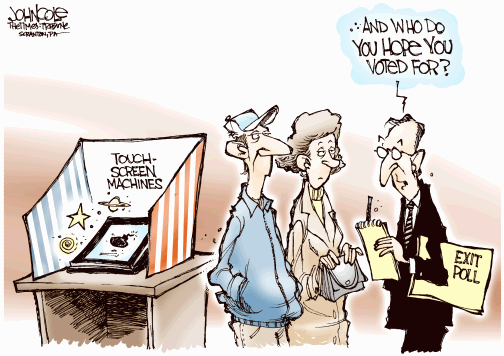
Election Day Musings

A few nights ago, we watched The Candidate, a movie made in 1972 with Robert Redford, about a guy who gets into politics for the right reasons, only to be overtaken by a phalanx of pollsters, media men and pundits.  What was remarkable about the movie was how fresh it seemed.  Apart from a few misplaced sideburns (and the complete absence of cellphones)  - the issues were the same, the soundbites were the same and the sorry smear tactics were - you guessed it - the same.

And on this midterm election day, you have to ask yourself, as the New York Times article did recently, Would You Run? 

At the federal level at least, it's not a very appealing proposition.  Let's face it, politicians usually place high on lists of top ten most despised professions.  Campaigning today involves massive fund raising, taking extreme partisan positions on any issue of importance ("to motivate the base") and digging up as much dirt on your opponent as you can feasibly find so that you can run attack ads aimed at destroying his or her credibility. 

Any candidate worth their salt will have a real desire to fix something very broken in our society (currently, the entire city of Washington DC is apparently deeply fractured, causing long time insiders to campaign on a platform of change).

Yet the reality is, of course, that most Congressmen and women have little or no opportunity, individually, to change much at all.  Instead, they must work collaboratively  - often across the aisle - to achieve any legislation.  Which results in legislative compromise, creating voter disgust, contributing to a whole new wave of candidates who think that they have the answers, and could do a better job.

Perhaps, given this merry-go-round of disillusionment it is not surprising that getting out the vote is such hard work.  Midterm elections typically produce a turnout of less than 40% of the voting age population.  It will be interesting to see if this one is any different. 

But the pollsters and media men and pundits are getting cleverer at manipulating those figures.  Over the weekend, I read a fascinating piece in the Times' Sunday Magazine, about how applying peer pressure can influence turnout.   And today, in the social laboratory that is Facebook, I am seeing it happening in realtime, as an online meter ticks up every time another Facebooker clicks to say that they voted.  The current tally is close to 6.5 million, and it is mesmerizing to watch how fast it is increasing.  

Whatever happens tonight, the political landscape will change.  It could be the carnage that The Onion predicts, or it could be the more measured outcome suggested by Five Thirty Eight.  Either way, by the time many of you are reading this, there will be some new sheriffs in town.

Let's hope that they have a better strategy for politics than going in with all their guns blazing.

Monday, October 25, 2010

Privacy is Dead

I smell a Pulitzer in the Wall Street Journal's recent coverage of digital media marketing techniques, "What They Know", a series on how  marketers are "scraping" data about consumers from our browsing history, our membership of social media sites and our purchasing history, and in some cases selling that data commercially or to politicians so that we can be more effectively targeted.  It should be required reading for anyone who ever opens a browser, and certainly it has interesting things to say about child safety, and tracking that takes place on sites for kids such as Club Penguin and Barbie.com (parents, click here).

The problem is, that (even if you've not read any of the articles in the series), you kinda knew this was happening anyway.

Anyone who has a Gmail account already knows that the ads they view are determined by the words they type into their e-mails.  Ditto Facebook, which spent the last ten months offering me ads for wedding dresses and bridal planners, doubtless based on my regular updates about our events.  I just checked what they are currently pushing (Volkswagen Jetta for me - although obviously, that will differ vastly for the rest of you folks) - and I'm not sure if that is because one of my friends "Liked" the Jetta, or because somewhere in the data mining they've done on me, they've found a reference to Lucky, my fabulous Volkswagen Beetle.

So what does it all mean?  The purpose of this post is not to encourage bunkerism, or suggest that a return to good old-fashioned paper and pen would be a good idea.  It's more to encourage friends and family (and the few hundred others who apparently read this blog occasionally) to get smart.  I've been dismayed recently by some of the posts from folks I respect that have appeared on Facebook or Linked In.  People I used to work with have posted pretty lurid details of running up bar tabs on work junkets that finished at 6am, only to go to work again at eight.  How can they be so reckless?  Never mind the ethics of whether that's how you should be spending your company's dollar...Do they really think that no-one connected to the company will see these posts?  Have they forgotten how many current, ex and future colleagues could be reading this?  Unfortunately for them, your online imprint is pretty much like an elephant.  It never forgets.  Earlier this year, HuffPo collated 13 incidents of folks who had gotten fired over their Facebook posts.  That's probably a drop in the bucket.  It happens.

I think part of the problem is the desire to present an interesting persona online.  But while most of us want to avoid being the boring Doreens who post such zingers as "Went to Starbucks today" or "I hate Mondays", we also need to find a healthy balance that avoids deeply racy or potentially compromising posts, just to impress our mates.  Think about that audience.  I'm friends with folks online with whom I haven't communicated in months, or in some cases, years.  There's only so much that they need to know about me.

Of course, for me, this is a particularly thorny issue, because as a marketer, I would be delighted to have access to this kind of rich data.  Targeting likely purchasers is the holy grail of marketing, and it has become ever more achievable in our new, information rich, world. But respecting customers is also a basic axiom of good marketing practice.  It's just not clear how many companies are really practicing that respect as they chase their next quarterly earnings goal.